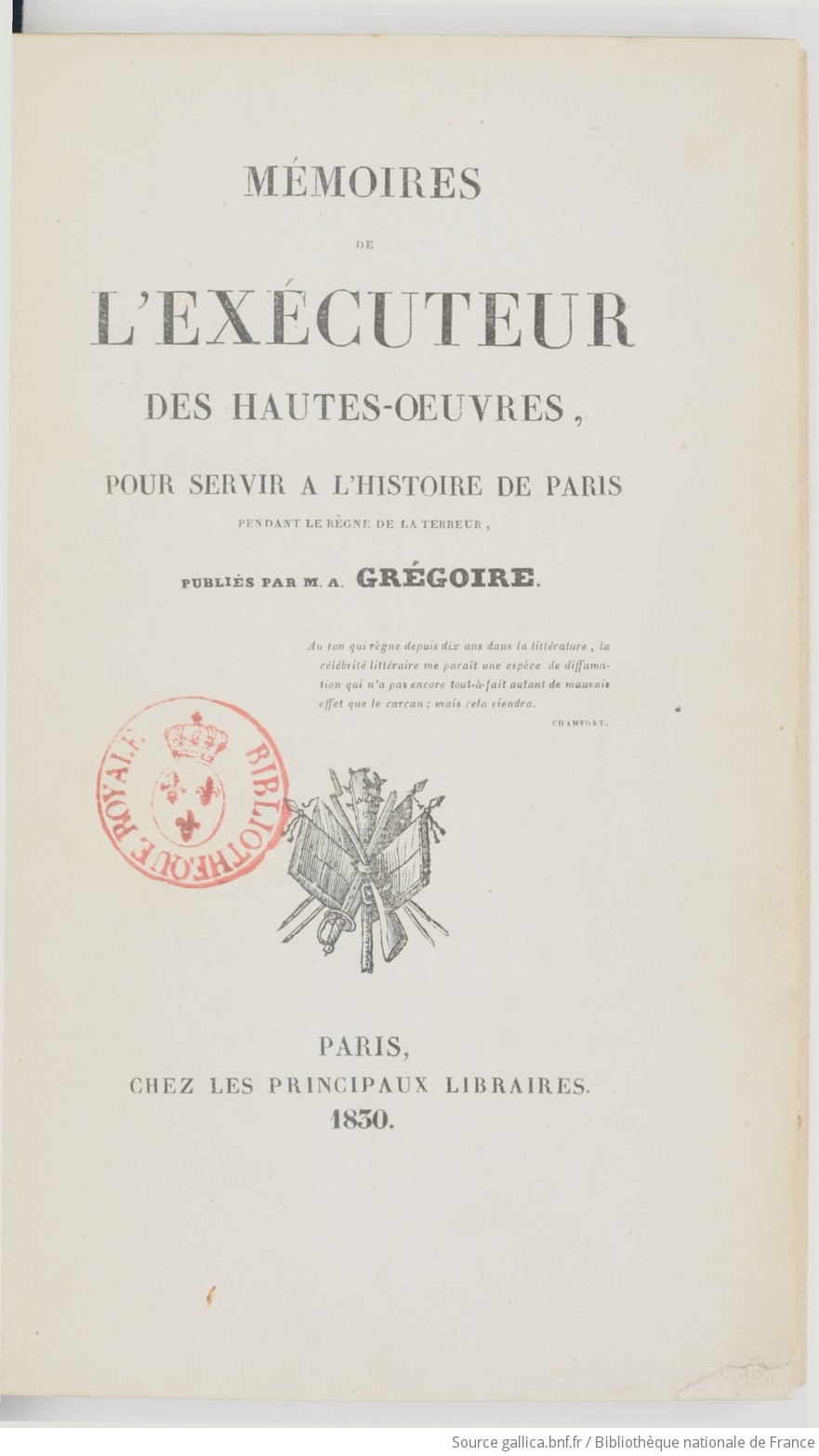
 The nineteenth-century works collectively known as the Memoirs of Sanson have long been treated as a single apocryphal publication. This article argues that such a view oversimplifies their history. The memoirs published in 1830–1831 and Henri-Clément Sanson’s Sept générations d’exécuteurs (1862–1863) were distinct editorial projects with different aims, different methods and structure and different historical value.
”’Memoirs of Sanson”’ (French: ”Mémoires de Sanson”) is the collective title commonly applied to several nineteenth-century publications associated with the Sanson family, a dynasty of Parisian executioners who served under the Ancien Régime, the French Revolution and the nineteenth century. The works combine family tradition, historical narrative, documentary material and editorial reconstruction. Their authorship and authenticity have been debated since the nineteenth century.1
Publication history
The first publications appeared in 1830 under the title ”Mémoires pour servir à l’histoire de la Révolution française”. The project was initiated by Louis-François L’Héritier (1789-1852) during the Bourbon Restoration and the second edition involved Gabriel Honoré de Balzac, who wrote at least part of the opening volume, notably about a mass, dedicated to Louis XVI. Henri-Clément Sanson later stated that Balzac’s opening narrative was based partly on family traditions supplied by Henri Sanson, but that its concluding episode was a fictional device intended to provide an origin story for the apocryphal memoirs.2 3 Henri-Clément’s detailed discussion of L’Héritier and the origins of the 1830–1831 publications appeared only in the original French introduction to the first volume (1862). It was omitted from the English translation (1876) and from the abbreviated preface to the revised French edition (1879), which contributed to later misunderstandings about the relationship between the different Sanson publications.
Presented as the recollections of Henri Sanson, son of Charles-Henri Sanson, the Memoirs were publicly repudiated by Henri, who declared that he had neither written nor authorised them and that they bore little resemblance to the papers left by his father. Publication was suspended at his request in 1830, although revised volumes continued to appear in 1831. (Henri Sanson was anglizised to Henry Sanson in later literature).
More than thirty years later, Henri-Clément Sanson, the last executioner of the family, undertook a new project under the title ”Sept générations d’exécuteurs, 1688–1847” (1862–1863). Volume I, II and III were published in 1862; Volume IV, V and VI were published in 1863.
In a substantial autobiographical introduction, he rejected the earlier publications as an unauthorised and romanticised account of his family’s history and presented his own work as a reconstruction based on family papers, correspondence, private notes, official records and printed historical sources. Contemporary advertisements and legal proceedings show that Henri-Clément was actively involved in the publication and regarded the work as his own, while disputes with his publisher concerned financial arrangements rather than the authenticity of the project itself.
This work differs markedly in conception from the publications of 1830–1831. Rather than presenting a continuous personal memoir, it combines autobiographical passages, essays on criminal justice and capital punishment, documentary transcripts, historical case studies and extended narratives covering both the Ancien Régime and the French Revolution. Henri-Clément regularly compares conflicting accounts, cites contemporary documents and historians—including the newspaper ”Le Moniteur universel”, and the authors François-Emmanuel Toulongeon, Louis Blanc and Jules Michelet—and incorporates material attributed to the Sanson family archives. The result is a hybrid historical work that combines family testimony, historical scholarship and literary narrative.
The ”Sept Générations d’Exécuteurs” enjoyed considerable public attention when it appeared. It was serialised in the French press, widely advertised, reviewed favourably for its literary style, and continued to be cited by historians and journalists well into the early twentieth century. Historians such as Jules Claretie (1840-1913) and G. Lenotre (1855-1935) drew upon both the published memoirs and the Sanson family collection, while distinguishing between the documentary material preserved by the family and its literary presentation.[Lenotre, G. (1893) La guillotine et les exécuteurs des arrêts criminels pendant la révolution : d’après des documents inédits tirés des archives de l’Etat.] Modern scholarship likewise treats the work as a complex nineteenth-century historical compilation whose documentary value must be assessed source by source rather than accepted or rejected as a whole. The different publications are therefore best understood not as a single set of memoirs, but as successive editorial projects reflecting changing literary, historical and documentary aims.
The ”Memoirs of Sanson” comprise two distinct nineteenth-century publishing projects associated with the Sanson family.
The first, ”Mémoires de l’exécuteur des hautes-œuvres and Mémoires pour servir à l’histoire de la Révolution française”, appeared in 1830. It was initiated by Louis-François L’Héritier during the Bourbon Restoration in France and developed with the assistance of Honoré de Balzac, who later acknowledged his contribution to the opening volume. Presented as the recollections of Henri Sanson, son of Charles-Henri Sanson, the work combined historical narrative with fictionalised scenes and dialogues, while explicitly acknowledging the role of both authentic documents and family traditions in reconstructing the history of the Sanson family. Henri-Clément Sanson publicly repudiated the publication, on 3 October 1840, declaring that he had neither written nor authorised it and that it bore little resemblance to the papers left by his father.4 At Henri’s request the project was suspended in 1830, although a revised ”Mémoires pour servir à l’histoire de la Révolution française” continued to appear in 1831.
More than thirty years later, Henri-Clément Sanson (1799–1889), the last executioner of the family, undertook a new edition under the title ”Sept Générations d’Exécuteurs, 1688–1847” (1862–1863). Published by Paul V. Dupray de la Mahérie, the six-volume work was conceived as an independent reconstruction of the history of the Sanson family based on family papers, correspondence, official documents and printed historical sources. Contemporary advertisements presented it as a documented family history rather than a continuation of the earlier memoirs, while legal proceedings between Henri-Clément Sanson and his publisher demonstrate that he remained actively involved in its publication and claimed authorship of the work.
Although the journalist d’Olbreuse, is believed to have assisted with the preparation of the text, the extent of his contribution remains uncertain.
Sept Générations d’Exécuteurs, 1688–1847
A six-part family chronicle from 1862/1863 with an extensive introduction and notes. Edited by Henri-Clément Sanson; Paul Dupray de la Mahérie as publisher and a publicist known as d’Olbreuse, though nothing at all is known about him, not even his first name.
The 1862–63 edition is not a collection of sensational family stories, but a well-documented historical work in which Henri-Clément Sanson attempts to synthesize family papers, official documents, parliamentary reports, and existing historical accounts. He attempts to describe the entire institutional process of Thermidor:
Content and historical character
The first volume of the Memoirs start with a historical and philosophical approach on death penalty from the Middle Ages, the guillotine, and torture– around 200 pages. On page 208 he wrote about the first edition in 1829/30:
These two volumes are moreover a tissue of mendacious allegations and puerile inventions, devoid, I will not say only of truth, but even of plausibility. Here is the version that the authors had imagined to place in the mouth of my father about the origins of our family. In Vol. I, on page 211: If I have dwelt so long on these apocryphal Memoirs, it is so that they can never be opposed by people of good faith to the work that I am publishing today, and which is the only true repository of the memories of my family. I found in my father’s papers, a draft of the letter that he intended to write to the newspapers to deny these false Memoirs: Several respectable people, who are willing to honor me with their esteem, have seemed to believe that I was the author of the Memoirs of Sanson, executor of criminal judgments. I declare that I have never written anything similar and that the memories that my father left us offer no analogy with this publication, of which all the details are romantic.
Henri-Clément Sanson compares sources. He refers to historiography, he mentions Barrère, Michelet, Toulongeon and Blanc, and contrasts this with a family tradition: Michelet is wrong, Louis Blanc is wrong, Barrère is untrustworthy and Toulongeon is more convincing.
Page 205-432 are about the origin of the family in Abbéville and Dieppe, who moved to Paris in 1685. The presence of Charles I Sanson in the capital cannot be proved before the year 1688.
The second volume is about François Damiens, Lally-Tollendal and the Chevalier de la Barre. The third volume deals with Charles-Henri Sanson, his case with the press in 1790, the events in August 1792, but he does not mention the death of his supposed uncle Gabriel Sanson (and was not buried in the family grave at the cemetery Monmartre!).
Henri-Clément Sanson recounts the death of an unnamed young assistant who collapsed while exhibiting a severed head, attributing the death to an apoplectic seizure. Later accounts identify the assistant as Gabriel Sanson and often state that he slipped from the scaffold, but these details are not explicit in Henri-Clément's narrative.

The oft-repeated account that Gabriel Sanson died after falling from the scaffold in 1792 is widespread in modern literature, but contemporary newspaper evidence has proved elusive. Henri-Clément Sanson's own narrative describes the death of an unnamed young assistant without identifying him as Gabriel.
It ends with the execution of thiefs and forgerers and the death of King Louis XVI.
Volume III deals with the mass for the executed king, Corday, Custine, the Queen Marie-Antoinette, the 21 Girondins, Philipe Égalité, Madame Roland, and Bailly. The diary of his grandfather begins afterwards, on 16 November 1793. Vol. IV contains details about Danton, Desmoulins, not about their trial, but the execution, Madame Élisabeth, 9 Thermidor, and Robespierre.
To describe the events in the Convention, he cites Le Moniteur universel. Henri-Clément repeatedly mentions: the vice-president Toussaint-Gabriel Scellier; Liendon, substitut de l’accusateur public; the delay until 12:30 p.m.; the legal difficulty regarding their identification and the route to the guillotine. His description of the execution is strikingly matter-of-fact: 6:15 p.m.: arrival at the Place de la Révolution; Gobeau is the first to be executed. Saint-Just embraces Couthon. To Robespierre, he says only: “Adieu.” Robespierre responds with nothing more than a nod.5
Charles Henri Sanson listed the names of a few thousand people, who were executed during the Grand Terreur.6 Then the work also becomes documentary, quasi-administrative and almost prosopographic.
A hybrid historical work
The Memoirs function both as a counter to sensationalism and, at the same time, thanks to sensationalism. He depicts the executioner not as a sadist, but as a hereditary official of the state. This ties directly into Cesare Beccaria, the Italian jurist and philosopher; the legitimacy of punishment; the role of the state; and the moral responsibility of the executioner. This shows that the Memoirs also offer insights into: citizenship; the social status of executioners; the Reign of Terror; the legitimacy of the death penalty.
The 1862–1863 edition has increasingly been studied independently of the earlier publications because it presents itself not as the personal memoirs of Henri Sanson, but as a documented reconstruction by his son Henri-Clément Sanson. The 1862–1863 edition should not be regarded as a revision of the 1830–1831 memoirs, but as an independent work written partly in response to them.
Reception and historiography
The 1830–1831 Memoirs were widely regarded as a literary undertaking, whereas the six-volume ”Sept Générations d’Exécuteurs” followed a different editorial approach. Contemporary reviews praised its literary qualities, it was serialised in the French press, and it continued to be cited by journalists and historians into the early twentieth century. French historians such as Jules Claretie and G. Lenotre drew extensively upon the Memoirs and the Sanson family collection, while distinguishing between documentary material and its literary presentation.
Modern historians generally adopt a more nuanced assessment than earlier criticism allowed. Rather than accepting or rejecting the work as a whole, they evaluate its different components separately, distinguishing between literary reconstruction, family tradition and documentary evidence. The destruction of many judicial and administrative archives during the Paris Commune in 1871 has made independent verification of numerous details difficult, while at the same time preventing the complete dismissal of material that may have derived from family papers no longer extant.
Contemporary reviews, advertisements and newspaper serialisations treated the 1862–1863 edition as a major historical publication, and it continued to be cited in the French press into the early twentieth century.
Memoirs of the Sansons: From Private Notes and Documents (1688–1847)
”Memoirs of the Sansons: From Private Notes and Documents (1688–1847)” (published in 1876) is an abridged English translation based on ”Sept générations d’exécuteurs” (1862–1863), not on the earlier memoirs of 1830–1831. The anonymous translator stated that he had shortened passages that wandered from the narrative while preserving what he regarded as the essential historical material. The preface describes the work as literary in style but argues that it was substantially inspired by, and probably written under the direction of Henri-Clément Sanson.
Summary in French
Henri-Clément Sanson présente son ouvrage comme bien davantage qu’un simple recueil d’anecdotes judiciaires. Dans sa longue introduction autobiographique, rédigée sur un ton à la fois personnel et justificatif, il décrit sa révocation en 1847 comme le terme de la longue histoire de sa famille dans l’exercice des hautes œuvres. Il présente cette fonction héréditaire comme un devoir imposé par la naissance plutôt qu’un choix personnel, en insistant sur l’isolement social et le poids moral attachés au nom des Sanson.
Il explique avoir quitté sa charge avec soulagement et évoque son projet d’émigrer en Amérique afin d’échapper à la réputation qui poursuivait sa famille. Parallèlement, il présente les Sanson comme les dépositaires d’un patrimoine documentaire exceptionnel, affirmant que plusieurs générations d’exécuteurs avaient conservé des manuscrits, une correspondance, des documents officiels et des notes privées relatant non seulement les exécutions célèbres, mais aussi les événements politiques de leur époque.
Henri-Clément inscrit ainsi les ”Mémoires” dans une double démarche, historique et morale. Il affirme avoir entrepris ce travail afin de reconstituer l’histoire de sa famille à partir de sources manuscrites et imprimées, tout en prenant ses distances avec les ”Mémoires” publiés en 1830–1831, qu’il jugeait largement romancés. Son ouvrage mêle souvenirs familiaux, documents d’archives, extraits de sources contemporaines et commentaires historiographiques. Loin de défendre la peine de mort, il plaide à plusieurs reprises pour son abolition et présente l’exécuteur non comme un personnage sanguinaire, mais comme l’instrument involontaire de la justice, condamné par sa naissance à exercer une fonction héréditaire. Les ”Mémoires” se présentent ainsi à la fois comme le témoignage du dernier représentant de la dynastie des Sanson, une tentative de reconstitution documentaire de son histoire familiale et une réflexion plus générale sur la justice criminelle et la peine capitale.
References:
- Philippe Bourdin, « Sept générations d’exécuteurs. Mémoires des bourreaux Sanson (1688–1847) », Annales historiques de la Révolution française. URL : https://journals.openedition.org/ahrf/1561 ; DOI : https:// doi.org/10.4000/ahrf.1561 ↩
- Memoirs of the Sansons, From Private Notes and Documents (1688-1847), p.4-5, 26 ↩
- “…tout cela n’est qu’une fable imaginée pour donner une origine aux Mémoires apocryphes qu’on voulait publier.” In: Sept générations d’exécuteurs (1879), p. 400, 412 ↩
- Sept générations, Vol I, p. 212-214 ↩
- Faits recueillis aux derniers instants de Robespierre et de sa faction, du 9 au 10 thermidor ↩
- Reising (2024) Beccaria, the Executioner, and the French Revolution ↩
